
Exploring Tokyo as a Group Around Halloween: How Much Kart Trip Prep Can You Skip?
Exploring Tokyo as a Group Around Halloween: How Much Kart Trip Prep Can You Skip?
Once late October arrives, orange and purple start popping up on Tokyo's street corners. The billboards in front of stations shift to autumn colors, and café chalkboards gain an extra line for a seasonal menu item. If you're coming to Tokyo around this time with five friends, eight friends, or an even bigger crowd, where do you start?
Line up everyone's time off, narrow down where to go, and figure out how to get around. Just listing those three tasks is enough to flood a group chat with notifications. The reason is simple: the three decisions are tangled together. The dates depend on the destination, the destination depends on how you'll get around, and how you'll get around depends on the dates. Until you pin down one fixed point, the discussion just goes in circles.
In this article, I'll walk through how much prep work you can cut by making a Tokyo street kart experience that fixed point, the anchor of your trip. I'll also mark where the line falls: the parts you simply can't skip.
How Does Tokyo Look Different in October?
Let me start with one assumption. In the US, Halloween means going door to door around the neighborhood at night. In Japan, things work differently. Instead of people making the rounds of houses, the city itself slowly puts on seasonal decorations. Put simply, the focus shifts from the home to the city.
Pumpkin-colored decorations show up outside shops, and window displays change their color schemes. How much decorating happens varies from shop to shop and from year to year, though. If you show up expecting all of Tokyo to be drenched in Halloween, you might be a bit let down. As I see it, what makes Tokyo interesting at this time of year is that in-between state, when seasonal colors gradually blend into the everyday streetscape.
This is where the way street kart tours work comes into play. Each tour runs a set course for its location, led by a guide. So what you'll see in Tokyo in October is mostly decided by which location you pick. Choosing your scenery becomes a matter of choosing your location.
Here are the specifics. The Shibuya tours run through streets steeped in youth culture: the Scramble Crossing, the front of SHIBUYA109, Takeshita Street in Harajuku, and the zelkova-lined avenue of Omotesando. On the Akihabara tours, the main sights are the red-brick Marunouchi building of Tokyo Station, the Ginza 4-chome intersection with the Wako clock tower, and the rows of signs in Electric Town. The Tokyo Bay location's tours take you along waterfront roads with views of the 798-meter Rainbow Bridge and the 333-meter Tokyo Tower.
One more note: the Rainbow Bridge lights up in seven colors at night. Autumn is when the sun starts setting earlier, so the same course should feel quite different depending on the time of day. Which departure times are available differs by location and by day, though. If you're after night views, ask about it when you discuss your booking.
One more variable to keep in mind early on: the crowds around Halloween itself. Shibuya especially is hard to predict at this time, and how crowded it gets changes from year to year. If you're moving as a group, plan your meeting spot assuming it'll be crowded. I'll come back to this in a later section.
To Save Effort, Pick the Location First
If you break down why group trip planning goes off the rails, it usually comes down to "we can't agree on where to go." Someone wants Shibuya, someone pushes for Akihabara, and someone else says they want to see the ocean. In my five years in Japan, every time I've shown friends from my home country around, I've watched this one discussion eat up an entire week.
So here's a proposal to flip the order. If the kart experience is the centerpiece of your trip, why not pick the location first and arrange everything else around it? Once that one point is set, the area you stay in, the stations you use, and the places you visit before and after the tour all narrow down one after another. You get stuck because there are too many options; set one anchor, and everything else becomes a dependent variable. That's the logic.
Before comparing locations, though, check two things: who can drive, and how many of you will be driving. If those conditions aren't met, you'll have to start over no matter which location or date you choose. Street karts are vehicles that drive on public roads, so there are requirements to join. From what I could confirm in the available materials, participants must be 18 or older and hold a valid license to drive a four-wheeled motor vehicle. For foreign licenses, the required documents vary by country and license type, and the original paper license is required. If you don't have the necessary documents on the day, you can't participate, and you won't get a refund.
That's exactly why, before settling on a location or dates, you should share the driver's license information on the official website with everyone and have each person check for themselves. Only the license holder can tell which requirements apply to them. See the official website for details.
One more point on group size. According to the materials, a standard tour has one guide for up to six drivers. Larger groups are handled only at the Tokyo Bay location, where they're split into multiple groups for the ride. If more than six people will be driving, take this condition as given before you get to the location comparison below. Who you'll share the tour with, and whether your whole group can get into the same slot, are things to discuss when you inquire. See the official website for details.
What's Around the Tokyo Locations
Street Kart has nine locations nationwide, seven of them in Tokyo. However, Akihabara's first and second locations are in almost the same spot, and so are the Shibuya location and Shibuya Annex. So don't picture seven bases scattered all over Tokyo. When choosing as a group, it's easier to think in terms of four areas: Shibuya, Akihabara, Tokyo Bay (Shin-Kiba), and Shinagawa.
The Shibuya location is listed as a 5-minute walk from Shinsen Station on the Keio Inokashira Line and a 10-minute walk from Shibuya Station. If you go with Shibuya at this time of year, my impression is that it's an area where you'll see plenty of street decorations. As I mentioned earlier, though, the crowds are unpredictable.
The Tokyo Bay location is an 8-minute walk from Shin-Kiba Station, which is served by the JR Keiyo Line, the Tokyo Metro Yurakucho Line, and the Rinkai Line. Since the open waterfront scenery is the main draw, it's less about seeing street decorations and more about driving under the autumn sky by the sea.
The Shinagawa location is a 3-minute walk from Kita-Shinagawa Station on the Keikyu Main Line and a 10-minute walk from Shinagawa Station. Shinagawa Station is also a Shinkansen stop. If your group has members who want to join straight off the train when they arrive in Tokyo, it's worth putting on the list.
The Akihabara location is known for courses that run past Tokyo Station, Ginza, and Electric Town. It suits groups who want to see Tokyo's old face and new face in one continuous stretch.
If you're still undecided, narrow it down to a single criterion: pick the location with the fewest transfers from the hotel where everyone's staying. When tastes in scenery split the group, decide by ease of travel. There are as many preferences as there are people, but the number of transfers comes out to a single number once you count it. For big group trips, I think deciding by a criterion you can actually compare is the way to avoid arguments.
Group Schedules Are Easier to Align When You Change the Order of Decisions
Lining up everyone's schedules is hard no matter how many people are going. But just changing the order in which you decide things cuts down the back-and-forth considerably.
Once you've confirmed who meets the requirements and how many people are going, the next step is candidate dates. Something to know here: weekends tend to book up fast. Check with the official contact, along with your candidate dates, whether your whole group can join in the same time slot. If many members can take weekdays off, adding weekdays to the list widens your options. If you can only go on weekends, I recommend booking that much earlier. Giving them your headcount and several candidate dates speeds things along.
Reservations are accepted via Facebook, LINE, and email. Contact details are on the official website. Keep the structure simple here too: choose one representative for the group and make that person the point of contact. If the representative compiles everyone's names and license status, you'll also cut down on back-and-forth confirmations.
Prep You Can Skip, and Prep You Can't
Let me sort everything so far into what you can skip and what you can't.
First, you can skip planning a route. Courses are set for each location, and trained guides lead every tour, handling the route and safety according to Japanese traffic rules. There's no need to open a map app and figure out which road gets you to the Shibuya crossing. The flip side is that you don't choose the roads yourselves. Even if you think "I want to drive down that street too," the course is set in advance. Understand that from the start, and you won't be disappointed on the day.
Language prep can be skipped, with conditions. Guidance on the day of the tour is basically in English. If most of your group is comfortable with English, there's not much to worry about here. But if someone isn't strong in English, guidance in Japanese or other languages depends on the staff that day and isn't guaranteed. If that concerns you, ask in advance through the official website. Note that the official website itself supports 22 languages. Keep the website and the on-the-day tour guidance separate in your mind.
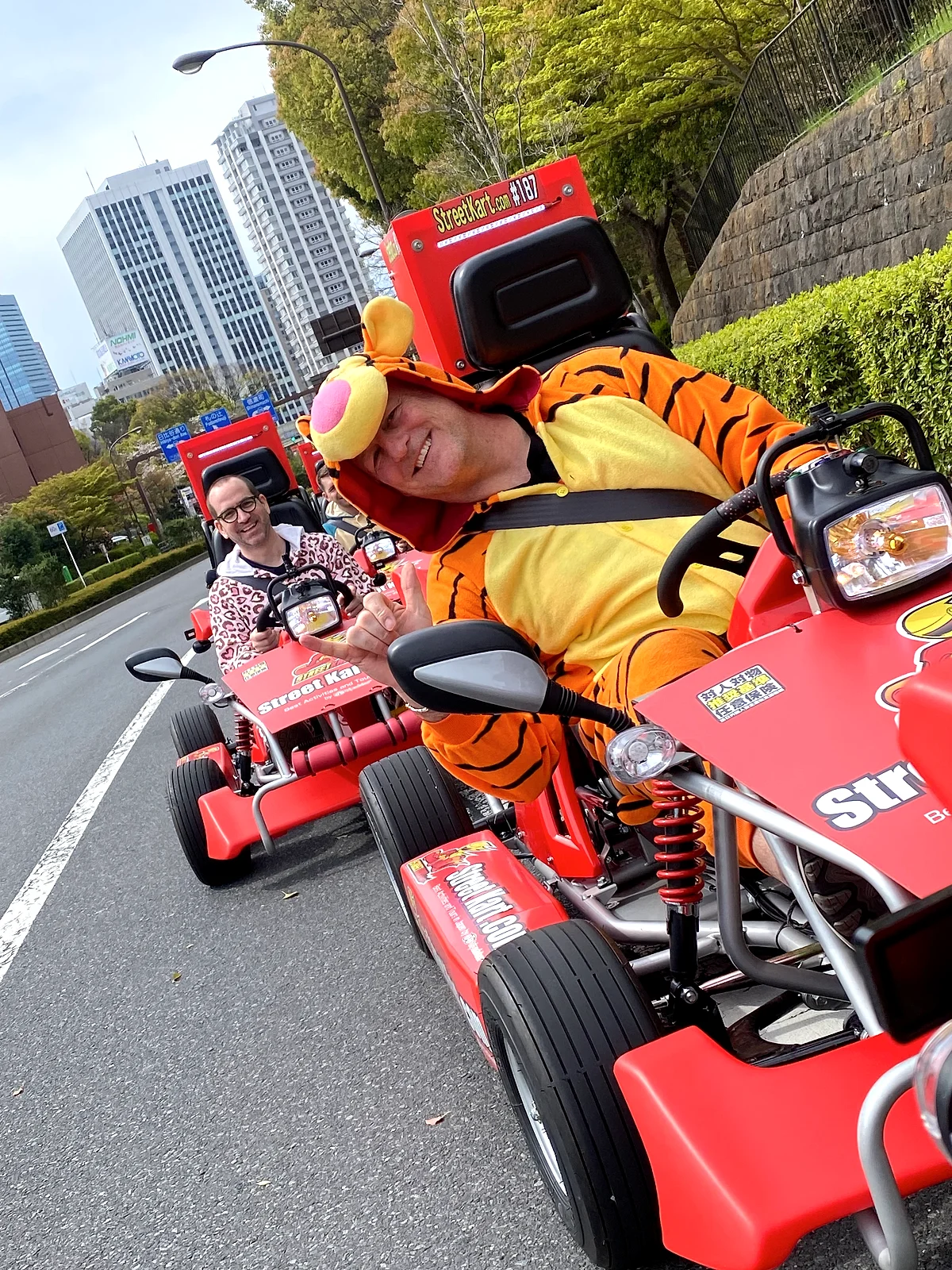
Costume prep isn't needed either. In other words, just because it's Halloween season doesn't mean you need to bring an outfit. If you ask on the day, you can rent one of Street Kart's original costumes on a first-come, first-served basis. You can, of course, also join in your regular clothes.
Arranging a car is unnecessary to begin with. In fact, don't drive there. The locations have no parking, and arriving by public transportation is recommended. You really want to avoid the situation where you're still hunting for parking as your reservation time closes in. Checking at every ticket gate that everyone has an IC transit card is a bit of a hassle, but the train is still the more reliable choice.
So what can't you skip? The license check and early booking I mentioned earlier. And meeting up. In my experience, what eats up the most time with a big group is waiting until everyone has arrived. In places like Shibuya around Halloween, where crowds are unpredictable, it's safer to skip the classic meeting spot in front of Hachiko and gather at a station close to the location instead. For the Shibuya location, making Shinsen Station your meeting point means you won't have to push through the crowds in front of Shibuya Station.
What to wear depends on the season and weather, so check the latest guidance on the official website. Autumn in Tokyo can feel quite different from day to day. If you paste the official guidance into the group chat, you'll also save yourself from answering "What should I wear?" one person at a time.
A word on budget too. Prices vary by season and time of day, so check the latest prices on the official website (kart.st). If you're splitting costs as a group, the quickest way is for the representative to check everything together and then share it.
Street Kart's Features from a Group Travel Perspective
Here's a point-by-point look at Street Kart's features with a group trip in mind.
First, the karts are single-seaters. There are no passengers; everyone takes their own wheel. You won't end up with one person driving while the others nap in the back seat. Everyone sees the same roads, each from their own driver's seat. Being able to talk about the same thing on the way back, like "How was that intersection?", is something I find really fun.
Second, there's the feel of the vehicle itself. When I drove, sitting so close to the ground made the buildings seem taller and the intersections wider than when I'm walking. You hear the buzz of the city past the engine noise, and the autumn air hits your face directly. It feels like the distance between you and Tokyo suddenly shrinks.
Third, the track record. As of November 2023, across all locations, they had run more than 150,000 tours, served more than 1.34 million customers, and collected more than 20,000 reviews with an average rating of 4.9 out of 5. When you're booking an activity none of you have tried before for a big group, I think these numbers are one useful thing to weigh.
Easy Spots for Groups to Visit Before and After the Tour
Since the tour follows its course, it's easier to plan side trips for before or after the tour. Here are places near each location you can drop by before or after your tour. None of them are on the course; they're all in the neighborhood of the location.
Around the Shibuya location, the Scramble Crossing, the Hachiko statue, and Shibuya Hikarie are all about a 10-minute walk away. Shibuya Scramble Square has an observation facility called Shibuya Sky. Look down over the city after your tour, and the intersection you just drove through at ground level should look like a completely different shape. Layering the view from below over the view from above is the kind of comparison I love. A short walk away are Dogenzaka's Ramen Yokocho (8-minute walk) and Shibuya Niku Yokocho (10-minute walk). It's an area packed with places to eat, so with a big group, having several options lined up makes things easier.
Near the Shinagawa location is Shinagawa Shrine, a 5-minute walk away. It's a shrine with a striking torii gate at the top of a stone staircase, just the right distance for a visit before your tour. After the tour, a stroll along the canals at Tennozu Isle, a 20-minute walk away, is also nice. The area is lined with art galleries and cafés, and you can spend a calm autumn evening, a different world from busy Shibuya.
From the Tokyo Bay location, Odaiba is about 10 minutes by car. DiverCity Tokyo Plaza and Aqua City Odaiba have plenty of restaurants.
Near the Akihabara location, Kanda Myojin is a 10-minute walk away. It's a shrine with 1,300 years of history. Walk just a little from the middle of Electric Town, and the atmosphere changes completely. After the tour, it's also easy to take the train about 10 minutes to Ginza for dinner.
What to Do Before Lining Up Schedules
Around Halloween, Tokyo is in the middle of slowly turning autumn colors. Your whole group seeing that scenery, each from behind their own wheel, should make for a pretty unforgettable travel memory.
To sum it all up in one line: the trick to preparation is the order you decide things. Check everyone's license requirements. Confirm how many people will drive. Pick a location. Have a few candidate dates ready. Set your fixed points in that order, and the tangled decisions become one straight line. And since weekends book up fast, move early once your schedule starts to take shape.
Start by checking each location's courses and booking contacts on the Street Kart official website. Drop a single link into your group chat, and your trip plan starts moving from there.
This article was originally written in Japanese and translated using AI. Some expressions may read unnaturally, and we appreciate your understanding. For the most accurate and up-to-date information, please refer to the official site at kart.st.
Street Kart is not affiliated with Nintendo or the Mario Kart series in any way. We do not provide costumes of Nintendo characters, and such costumes may not be worn during tours even if brought by participants.