
Seeing Shibuya from a Go-Kart: What Group Travelers Can Skip When Planning, and the 3 Things They Can't
Seeing Shibuya from a Go-Kart: What Group Travelers Can Skip When Planning, and the 3 Things They Can't
Four people, five people, six people. As a group gets bigger, the planning grows faster than the headcount. The reason is simple: the work doesn't scale with the number of people. It scales with the number of pairings between them. Who's staying where? Who's free when? Who wants to see what? Lining all of that up for everyone is enough to bury the group chat in notifications before you even leave.
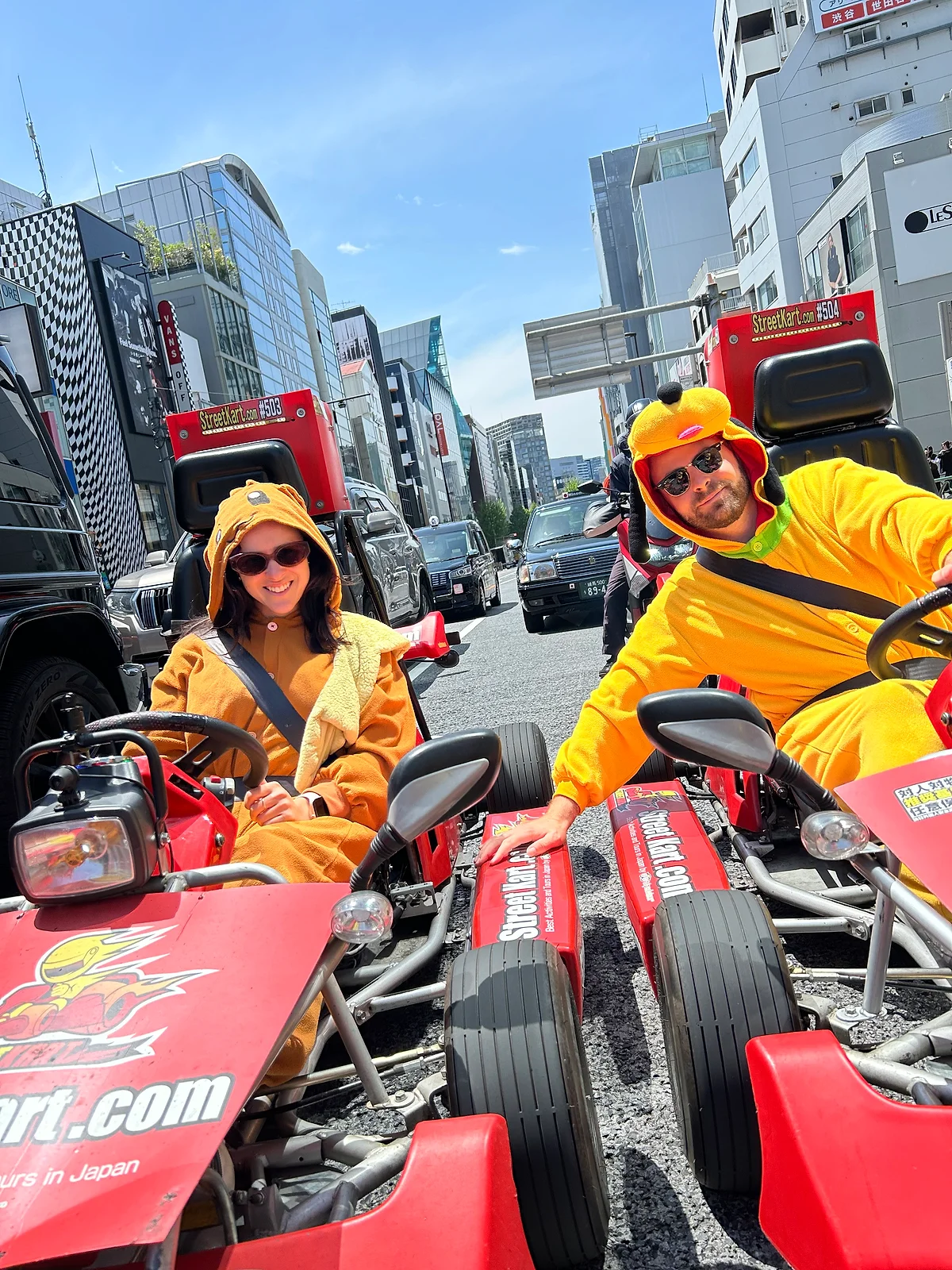
If the problem is the number of combinations, then making fewer decisions makes planning lighter. A Street Kart tour through the streets of Shibuya is one way to do that. As of November 2023 (all locations combined), Street Kart had run more than 150,000 tours for over 1.34 million customers, with more than 20,000 reviews and an average rating of 4.9 out of 5. The Shibuya plans in this article are for groups of up to 6 drivers. Groups of 7 or more are reportedly accommodated only at the Tokyo Bay location, so check the official website (kart.st) for details. You can't skip everything, though. This article first describes what Shibuya looks like from a kart. Then it sorts the planning into the parts you can skip and the parts you can't.
What kind of city do you see when you drive through Shibuya?
The Shibuya location lists these sights for its tours: Shibuya Scramble Crossing, the area around Shibuya Station with the Hachiko statue, the Harajuku and Takeshita Street area, Omotesando, and the areas around Meiji Jingu Shrine, Yoyogi Park, and NHK Hall. If you did these on foot, you'd spend the time between stops checking train transfers and staring at a map app.
Start with Scramble Crossing. The moment the light changes, waves of people surge in from every direction at once. When you cross on foot, you're part of that wave. From a kart's low seat, you watch the same wave from the outside. Look up and you'll see the facade of SHIBUYA109, Shibuya Hikarie by the station, and the glass walls of Shibuya Scramble Square. From this angle, the outline of the "new Shibuya" created by large-scale redevelopment comes into clear view.
As you get closer to Harajuku, the atmosphere changes completely. Colorful storefronts, the sweet smell of crepes, young people in street fashion. This is the heart of what's known as "kawaii" culture. Turn onto Omotesando and luxury brand buildings line the street under zelkova trees. The distance is tiny, but the feel of the city is totally different. Seeing that contrast in quick succession shows how the Shibuya area is put together.
Around Meiji Jingu and Yoyogi Park, the greenery suddenly gets dense. The Meiji Jingu forest covers about 700,000 m². That shift, where the feel of a forest appears just past the canyons of buildings, is to me one of the most surprising moments in Shibuya.
One thing to understand up front: on this tour, you follow a guide along a set route. You don't plan your own route. Even if some members have never driven on Japanese roads, they'll follow a trained guide and obey Japanese traffic rules. So if someone says "I want photos at the crossing" or "I want to shop on Takeshita Street," the sensible plan is to do that before or after the tour. That setup actually works in a group's favor. The next section explains why.
The idea: skip the "where to next" meeting entirely
I think what eats up time on group trips isn't the travel itself. It's the "where should we go next?" discussion. With six people you get six opinions, someone pulls up a map, someone goes to the bathroom, and before you know it 30 minutes are gone. Shibuya Station also has a lot of exits, so the bigger the group, the bigger the risk that someone gets separated.
With a guide leading the way, you can drop that discussion entirely. Scramble Crossing, Harajuku, Omotesando: the group doesn't have to decide which order to see Shibuya's signature sights in, or how. Follow the guide, and everyone sees the same scenery in the same order.
There's one more thing you can skip: the navigator role. Most groups have someone who somehow ends up in charge of the map. They spend more time looking at their screen than at the scenery, and when the trip is over, they're missing from all the photos. The karts are single-seaters with no passengers. So during the tour, everyone is behind the wheel, including whoever was stuck with the map. By design, nobody ends up as a passenger staring at their phone.
On group trips, roles inevitably split: the driver and the passengers, the person leading and the people following. Time when everyone is on equal footing, looking at the same view, is rarer than you'd think. I suspect that's exactly why it's the kind of time a group tends to remember.
The prep you can't skip comes down to just 3 things
Now for the main point. You can cut down on prep, but you can't eliminate it. If you're going as a group, don't leave these three to the organizer alone. Everyone needs to handle them.
Everyone checks their own driver's license
This is the most important one. The type of license you need, how International Driving Permits are handled, and what to bring on the day all depend on which country issued your license and what type it is. If someone in the group says "it'll probably be fine," that only applies to their own license.
Here are the basics. You need the original physical license. Digital licenses aren't accepted. You also need your passport for ID. And if you don't have the required documents on the day, you can't take part and won't get a refund.
Here's what I recommend: the organizer posts a link to the official page about driver's licenses in the group chat and asks, "Everyone check your own license and reply once you're good." Don't confirm the booking until everyone has replied. That one step prevents the worst outcome on the day: "I'm the only one who can't drive." If you're not sure about your case, don't guess. Contact them in advance.
Book early, especially for weekends
They say weekends tend to fill up. The bigger your group, the less likely it is that there's room for everyone at your preferred date and time. Once your trip dates are clear, I recommend locking in your kart day first.
There's one condition to check about group size. A standard group is up to 6 drivers plus 1 guide. Larger groups are reportedly accommodated only at the Tokyo Bay location. If you're thinking of bringing 7 or more people in Shibuya, check the official website or contact them before booking to find out how that would work.
You can book via Facebook, LINE, or email (booking@streetkart.com). What helps here is having one person handle all contact for the group. If several people reach out separately, the headcount and times can conflict, which actually makes more work. The simplest approach is for the organizer to collect everyone's preferences and send one message.
Meet at the shop, not the station
Shibuya has two locations, "Shibuya" and "Shibuya Annex," and both are in nearly the same spot in Maruyama-cho. Being so close makes them easy to mix up. Make sure everyone in the group knows which location you booked.
I recommend meeting directly at the shop rather than at Hachiko. The Hachiko statue is the classic meeting spot, which is exactly why it's always packed. With a big group, just finding everyone is a hassle. The shop is about a 10-minute walk from JR Shibuya Station, or about 5 minutes from Shinsen Station on the Keio Inokashira Line. If everyone is at different hotels, I find it easier for each person to take the train to the shop and meet up there.
Also note that the shops have no parking. Please use public transportation.
How much can you ease language worries?
If your group includes members who aren't native English speakers, someone might worry about understanding the instructions. Here are the facts first: on tour day, instructions are basically given in English.
Japanese or other languages depend on the staff that day and aren't guaranteed. So if anyone is unsure about English, it helps to decide ahead of time who will stay near them, pairing them with someone strong in English who can fill in the gaps.
The official website is available in 22 languages. That's only the website, not the instructions on the day. With that in mind, I recommend each person check whether their language is offered and read through the participation requirements and important notes before the trip.
If you learn just one Japanese word, make it "Sumimasen." It works for getting someone's attention and for asking people to let you through. In Shibuya's crowds, having that one word makes things a lot more comfortable.
Split up before and after the tour
Everyone is together for the kart ride. Because of that, you don't have to stick together before and after. That's my recommendation. The bigger the group, the more tiring it gets to insist on doing everything together. As long as you have one shared block of time, splitting up for the rest won't break the sense of traveling as a group.
Take the time before the tour. The photo crew can head to Scramble Crossing and the Hachiko statue (both about a 10-minute walk from the shop), while the relaxed crew grabs coffee near the shop. Shibuya Center Gai and Spain-zaka are also about a 12-minute walk away, the perfect distance for a quick taste of the city's energy.
After the tour, you could split into a group that wants to see the city from above and a group that wants to eat. Shibuya Scramble Square has an observation deck, Shibuya Sky, where you can look straight down on the crossing you just saw from ground level. Seeing the same city again from a different height, the route you drove sort of comes together in your head. That's what makes it fun.
For food, Dogenzaka Ramen Yokocho is about an 8-minute walk and Shibuya Niku Yokocho about 10 minutes. These alleys are full of small restaurants, and a big group can't always get seats together. Splitting up across a few places and meeting again afterward can be fun too. Shibuya Stream along the Shibuya River (about a 12-minute walk) has restaurants and cafes with a calmer atmosphere.
If you have time to spare, I also recommend going on to Meiji Jingu. It's about a 20-minute walk from the shop. After glimpsing the forest from your kart, you walk through the great torii gate on your own two feet. The same place feels completely different when you arrive a different way.
Set only a regroup spot and a rough time, and leave the rest free. That way, there's no need to squeeze the whole group's wishes into one plan.
One last short list for the organizer
Put it all together and the organizer has surprisingly little to do.
- Pick the kart day first and book early (if you have more than 6 people, check in advance how a larger group can be accommodated)
- Leave license checks to each person, and confirm only after everyone has replied
- Meet at the shop you booked (Shibuya or Shibuya Annex)
- Have each person check the details, like what to wear, rain policies, and how the day runs, on the official website before the trip
- Before and after the tour: split up, have fun, and regroup
Route planning, navigating, debating where to go: none of it comes along for the kart ride. With that out of the way, everyone gets to take in the buzz of the Shibuya crossing, the colors of Harajuku, and the shade of Omotesando's tree-lined avenue.
Planning less isn't about cutting corners. It means not deciding the things you don't have to, and making sure you nail the three you do. Once your group's dates start to come together, check the tour details and participation requirements on the Street Kart official website, and have the organizer reach out via Facebook, LINE, or email. Weekends tend to fill up, so book early. Contact them to check availability for your preferred date and time. Then you can spend the time you saved on Shibuya itself.
This article was originally written in Japanese and translated using AI. Some expressions may read unnaturally, and we appreciate your understanding. For the most accurate and up-to-date information, please refer to the official site at kart.st.
Street Kart is not affiliated with Nintendo or the Mario Kart series in any way. We do not provide costumes of Nintendo characters, and such costumes may not be worn during tours even if brought by participants.