
How Does Tokyo Change from Morning to Evening? What Your Friend Group Should Know Before Your First Street Kart Ride
How Does Tokyo Change from Morning to Evening? What Your Friend Group Should Know Before Your First Street Kart Ride
"Should we ride in the morning? Or the evening?"
When you're planning a Tokyo trip with a group of friends, that one question can stall the group chat. Some people like getting up early. Others want to see the city as the lights come on. Both sides have a point, because in Tokyo the same street can look completely different depending on the time of day.
This article walks first-timers through the planning, step by step: how a large group picks a location, lines up everyone's schedule, and books a Street Kart tour.
What to Know First: Tokyo's "Morning" and "Evening" Aren't Set by the Clock
Your first question is probably "So what time counts as evening?" The answer depends on the season.
Sunrise and sunset times shift as the seasons change. Leave at the same time in different months, and in one month the sky may still be bright, while in another the office windows are already lit up. So if you define a "morning tour" or "evening tour" by the numbers on a clock, the view you were picturing may not match what you actually see, depending on when you travel.
That's why it helps to decide on a different basis. When your group talks it over, start from "what do we want to see?" instead of the clock. Do you want to see the colors and shapes of buildings clearly while it's still light? Or do you want to watch the sky change color as the city lights come on? Put the question that way, and the group usually settles on an answer faster than you'd expect.
There's one more thing people tend to do in the wrong order. Which departure times are available may differ by location and by time of year. Once you've decided on the view you want, check the official website (kart.st) first to see whether you can ride at that time. If you line up everyone's schedules first and then look for a slot, you may find that "that time wasn't available" and have to start over from scratch. Check first, coordinate dates second. Sticking to that order saves you one round of rework.
Step 1: Decide Who's Driving and What You Want to See
The first thing to sort out on a group trip is who will be behind the wheel.
Street Karts are single-seaters, and passengers aren't allowed. Members who won't drive can't sit next to someone and ride along. That means you need to confirm at the planning stage whether each participating member can drive for themselves.
Driver's license requirements vary depending on which country issued the license and what type it is. Whether your license works as is, or whether you need additional documents, differs from person to person. Check the details on the official website. It's a good idea for each person to check the other requirements, such as age, before the trip as well. Rather than having the organizer look everything up for everyone, I think it's more reliable to send the official website link to the whole group and have each person check their own situation, since a lot of the license details are things only the license holder knows.
Having members who won't drive doesn't wreck the plan. Just arrange somewhere near the location where they can spend time during the tour. The next step introduces spots near each location, so consider splitting into a "driving crew" and a "walking crew" and meeting up after the tour.
Step 2: Compare Each Location in the Morning and the Evening
Street Kart has 9 locations nationwide, 7 of them in Tokyo. However, Akihabara Store 1 and Store 2 are in nearly the same place, and so are the Shibuya store and Shibuya Annex. Keep in mind that you're not choosing between seven separate areas of Tokyo.
Each tour follows a fixed course for that location, led by a guide. In other words, the location you choose sets the overall scenery you'll see. Picking a location is a choice about "where to ride" and also about "what to see." That's what makes comparing the locations interesting.
Tokyo Bay (Shinkiba) is themed around the sea and bridges. The route information lists Rainbow Bridge and Tokyo Tower. Rainbow Bridge, 798 m long, is a suspension bridge spanning Tokyo Bay, lit up in seven colors at night. In daylight, you'll get a clear view of the bridge's frame against the blue water. Once the lights come on, the same bridge turns into a band of light floating over the bay. The same goes for Tokyo Tower, completed in 1958 and 333 m tall: by day you can clearly see its red-and-white steel structure, and at night you'll view it lit up from a distance. If you want to make use of the morning, one option is to stop by Toyosu Market (10 minutes by car) before the tour. The market is busiest from early morning through late morning. For a slot closer to evening, it also works well to walk around Odaiba first and then take in the waterfront scenery on the tour. It's an 8-minute walk from Shinkiba Station.
Akihabara Store 1 and Store 2 list the Marunouchi Station Building of Tokyo Station, Ginza, and Akihabara Electric Town on their route information. The red-brick station building, which opened in 1914 and finished restoration work in 2012, shows off the red of its bricks best in sunlight. The Wako clock tower at the Ginza 4-chome intersection and the department stores along Ginza Chuo-dori should also feel quite different in daylight than when the lights come on. The signs lining Chuo-dori in Electric Town look like a different city at midday than at dusk. I'd also recommend visiting Kanda Myojin Shrine (10-minute walk) before the tour to settle your mind before setting off. Store 1 is a 3-minute walk from Suehirocho Station, and Store 2 is a 7-minute walk from JR Akihabara Station.
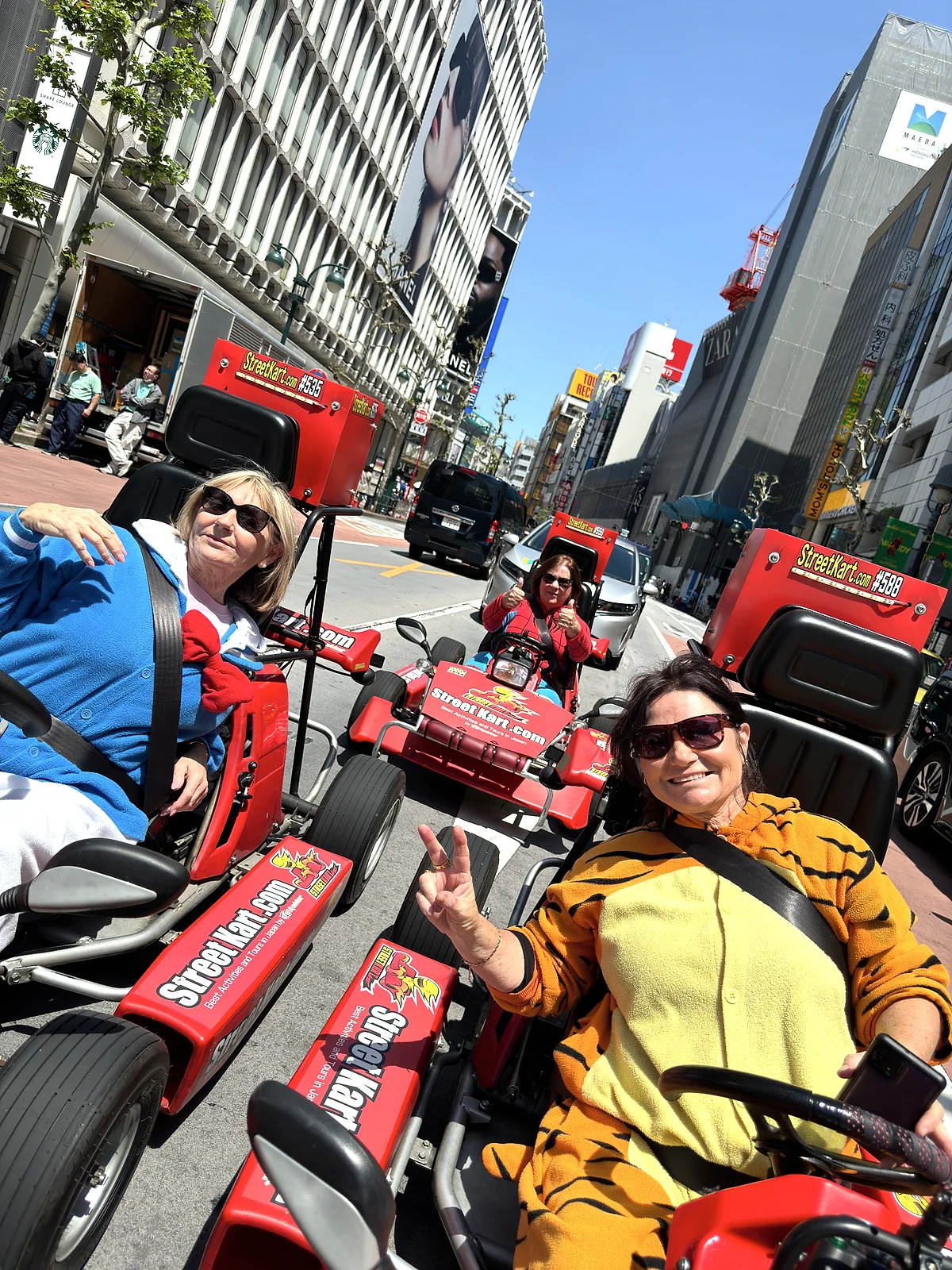
Shibuya and Shibuya Annex include Shibuya Scramble Crossing, Harajuku's Takeshita Street, and Omotesando on their route information. At the crossing, said to be crossed by 3,000 people at once, the flow of people changes with the time of day. Along Omotesando's zelkova-lined avenue, daylight gives you a good look at the contrast between the color of the leaves and the row of buildings designed by architects. You could take a break at Blue Bottle Coffee Shibuya (10-minute walk) before the tour, or stroll through the forest at Meiji Jingu (20-minute walk) on your way. For groups who want an evening view, Shibuya Sky (10-minute walk), the observation deck of Shibuya Scramble Square (230 m tall), is another option. It's a 5-minute walk from Shinsen Station.
Shinagawa lets you see both the high-rise district and the waterfront. The route information lists the skyscrapers around Shinagawa Station, Rainbow Bridge seen from the Shinagawa side, and Tokyo Tower in the distance. Climb the stone steps at Shinagawa Shrine (5-minute walk) before the tour. Stop into a café at canal-side Tennozu Isle (20-minute walk) after the tour. I think what makes Shinagawa convenient is how easy it is to plan the before and after for either a morning or an evening slot. It's a 3-minute walk from Kita-Shinagawa Station.
Step 3: Fit Everyone's Schedule into One Slot
This is where group travel really gets going. The more people you have, the more work it takes to align schedules. Personally, I think going in the following order keeps it manageable.
First, narrow your options down to 2, 3 combinations of "location × daylight hours / when the lights come on." For example, "Shibuya, while it's light" and "Tokyo Bay, as the lights come on." If you start with ten options, there are too many combinations to check against everyone's availability, and the discussion never wraps up.
Next, have everyone name several days during the trip when "the whole group can make it." The goal is for everyone to ride in the same slot, so this is something you need to align properly once. On your arrival day, travel fatigue and transit delays are hard to predict, so you'll feel more at ease booking a day with a bit of buffer.
Then it's time to book. Weekends tend to fill up, so act early once your dates are set. If some members can do weekdays, keeping weekday options open widens your choices. Reservations are accepted via Facebook, LINE, and email (booking@streetkart.com). When you reach out, include the country that issued each driver's license, the number of drivers, your preferred location, and your preferred date and time all at once. If your first message has all the necessary information, you'll cut down on back-and-forth.
Depending on your group size, whether everyone can fit into your preferred slot may vary. I can't say for certain here, so tell them your group size when you inquire and discuss it. For operational details such as how tours are organized, please check the official website.
As for cost, prices vary by season and time slot, so please check the latest prices on the official website (kart.st). If the organizer is paying for everyone, noting down the date you checked will make settling up later much quicker.
Finally, put the "confirmed location, date, and meeting point" into a single message in the group chat and pin it. That way, members who join the conversation partway through won't have to scroll around looking for it. It's a small task, but it really works.
Step 4: Getting Everyone Together Smoothly on the Day
Once your booking is confirmed, decide how you'll move on the day.
I recommend meeting at the nearest station rather than in front of the location. None of the locations have parking, so please use trains or other public transportation. Gather everyone at the station, then walk to the location together. Doing it this way reduces the chance of one person getting lost and the whole group having to wait. There's a safety briefing on the day, so set your station meeting time early enough to arrive with time to spare.
When meeting at a station, it's best to decide exactly which kaisatsu (ticket gate) you'll meet at. Large Tokyo stations have many ticket gates, and "I'm at the station" isn't always enough to find each other. I've lived in Japan for five years, and the number of exits at Shibuya Station still surprises me. Share the location in Google Maps, down to the exit name, for peace of mind.
There are convenience stores such as 7-Eleven, FamilyMart, and Lawson within a 5-minute walk of the locations. If you want to buy drinks or use an ATM, take care of it before meeting up so you'll have more time. The locations have restrooms and Wi-Fi, so you can check maps and messages after you arrive.
Tours are generally guided in English. Guidance in Japanese or other languages depends on the staff that day and can't be guaranteed. If any members are unsure about their English, it's a good idea to ask in advance. While driving, focus on the guide's instructions and don't touch your phone. If you agree at the start to take photos before and after the tour, everyone can drive with peace of mind.
If you have a "walking crew" who won't be driving, decide how they'll spend time during the tour too. There are easy places to pass the time near each location, such as Center Gai in Shibuya (12-minute walk), Animate Akihabara in Akihabara (2-minute walk), and the Kita-Shinagawa shopping street in Shinagawa. If you also decide where to meet up and how you'll signal it, things will go smoothly after the tour.
What Makes Street Kart Special
Apart from the logistics, I want to touch on what it feels like to drive a kart. As you drive, it feels like you're taking in the sounds and wind of the city with your whole body. You should be able to feel the difference between morning air and evening air while you're behind the wheel. You get to experience how Tokyo changes through the day not just with your eyes but with your body. To me, that's what makes Street Kart so much fun.
Here's the track record so far. As of November 2023, across all locations, there had been over 150,000 tours, over 1.34 million customers, and over 20,000 reviews, with an average rating of 4.9 out of 5.0. These figures are as of November 2023 and may differ from current numbers, but I think they're useful to consider.
One Last Look Before You Message the Group Chat
To sum up: morning in Tokyo is when building outlines stand out clearly. Evening is when the colors of the sky give way to the city lights. Neither one is the right answer. Talking with your group about "what we want to see" can turn out to be the most fun part of planning the trip.
There are three things to do next. Drivers check their license requirements. Narrow your location and time options down to 2, 3. Share the days when everyone can make it. Once that's settled, reach out via Facebook, LINE, or email with the license-issuing country, the number of drivers, and your preferred location and date/time. Weekends tend to fill up, so I recommend getting in touch early, as soon as your dates take shape.
Whether it's the same Rainbow Bridge or the same Omotesando, the Tokyo you see changes with the time you drive. Why not decide with your friends which Tokyo you'll go see?
This article was originally written in Japanese and translated using AI. Some expressions may read unnaturally, and we appreciate your understanding. For the most accurate and up-to-date information, please refer to the official site at kart.st.
Street Kart is not affiliated with Nintendo or the Mario Kart series in any way. We do not provide costumes of Nintendo characters, and such costumes may not be worn during tours even if brought by participants.