
How Does Tokyo Look Different by Day and by Night? Choosing a Street Kart Tour by How Much Group Trip Planning You Can Skip
How Does Tokyo Look Different by Day and by Night? Choosing a Street Kart Tour by How Much Group Trip Planning You Can Skip
The same intersection can look like a different city by day and by night. In Tokyo, that happens a lot.
In Shibuya during the day, you notice everything: the ads on the building walls, the colors of the clothes on passing crowds. After sunset, the details fade into the dark and the light alone outlines the city. Deciding between day and night when you plan a trip looks like a matter of taste. Once your group grows to 5, 8 or 10 people, though, it becomes something else, because the choice between day and night decides how much preparation you have to do.
This article breaks down the differences between daytime and nighttime Tokyo by asking one question: how much planning can you skip? The example is a street kart tour that follows a guide along Tokyo's public roads. It goes through how the views differ and how the logistics differ, so that groups who haven't picked a time yet can work out which one fits them.
The same Tokyo streets show you different things by day and by night
The first thing to understand is that the difference between day and night is more than light versus dark. What changes is the type of information you take in.
Daytime Tokyo: materials, signs and the flow of people
During the day, most of what you take in comes from building materials and written signs.
The Akihabara shop's route lists the Marunouchi Station Building of Tokyo Station as a highlight. This red-brick station opened in 1914 and finished its restoration in 2012. In daylight, the red brick stands out sharply against the bands of white stone. You can also follow every detail of the Wako clock tower in Ginza during the day. When you reach Akihabara Electric Town, the signs stacked up the buildings hit you all at once. English-speaking travelers won't be able to read most of the kanji and katakana. That "can't read it" feeling, though, is exactly what makes you feel you're really in Tokyo.
On the Shibuya shop's route, look out for the zelkova trees lining Omotesando and the brightly colored storefronts of Takeshita Street in Harajuku. Both areas are all about color and texture, so you get more out of them during the day.
Daytime also shows you how people move. When the lights change at the Scramble Crossing, crowds pour in from every direction at once. You can only see that rhythm in Shibuya during the day.
In short, daytime Tokyo is a city you enjoy by reading it.
Nighttime Tokyo: light takes over and details disappear
At night, you see much less. What remains stands out more for it.
The clearest example is the Rainbow Bridge, which appears on the routes of the Tokyo Bay shop (Shinkiba) and the Shinagawa shop. This 798 m suspension bridge is lit up in seven colors at night. In the daytime it's just a white structure; at night it looks like a single line of light drawn across the bay. Beyond it stands Tokyo Tower, 333 m tall.
In Akihabara and Shibuya, the night light is different from a bridge or a tower. Light from signs and building screens reflects off the road, and the whole city blurs into color. The text you couldn't read by day now reaches you as blocks of color.
In short, nighttime Tokyo is a city you enjoy by looking at it.
There's one catch. Night views are easy to enjoy because the details fade, but the time it gets dark changes a lot by season. At the same hour, the sky in summer looks nothing like the sky in winter. So this article won't say what time "night" starts. Check sunset times in Tokyo for your travel dates with a weather app or similar, and plan from there.
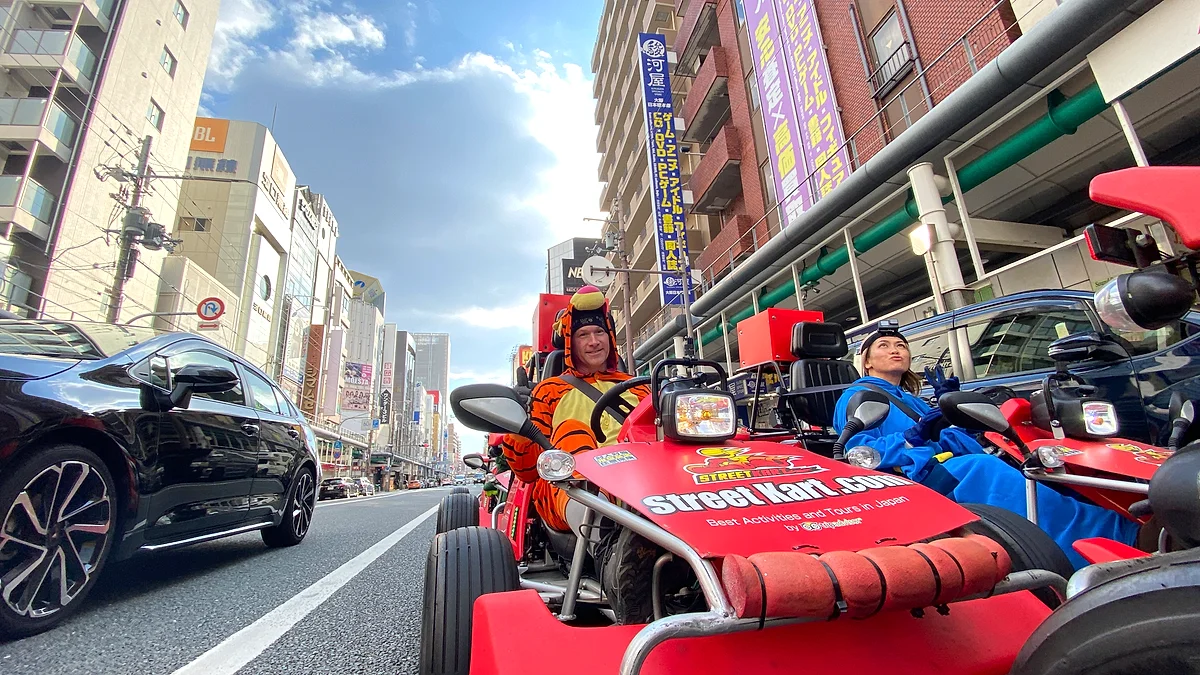
On a street kart, you experience this day-and-night difference looking up at the city from a low seat. What I find interesting is how a lower viewpoint changes the way familiar buildings look. By day, the textures of the buildings feel closer than usual; at night, it's the colors of the light. You also feel the wind and the sounds of the city directly on your body.
Before comparing day and night: what a street kart tour lets you skip
Before comparing day and night, let's establish a baseline. What preparation can you drop from the start on a street kart tour, day or night? For a group organizer, this matters more than you might expect.
The first is planning the route. Each Street Kart shop has its own set courses, and a guide leads the way. The organizer doesn't need to figure out the order of stops or where to turn. To find out whether a particular route can be arranged, ask the official contact when you book. If you want to visit somewhere that isn't on a course, the simplest approach is to plan it before or after the tour.
The second is navigation. A guide drives at the front. Even if some members don't know Tokyo's roads, nobody needs to be put in charge of memorizing the route.
The third is language. On the day of the tour, guidance is basically in English. Whether you can get guidance in other languages depends on the staff that day and isn't guaranteed. If some members aren't comfortable in English, asking ahead of time takes one worry off the day. Note that the website is available in 22 languages, but that applies to the site only, not to the language used on the tour.
To sum up, you can skip two jobs: deciding where to drive, and finding someone who knows the roads. For language, you'll need to check ahead if anyone needs something other than English. That's the starting point for the comparison.
What you can't skip: the bigger the group, the earlier you should start
On the other hand, what preparation can't you skip? For groups, this is where most of the work is.
The first is checking driver's license requirements. Since the tour runs on public roads, every participant has to meet driver's license requirements. What you need depends on the country that issued your license, and the details vary widely, so this article won't quote just part of them. Every member should check their own requirements on the official website.
If the organizer tries to work out everyone's requirements alone, planning grinds to a halt. My recommendation is to split the work: each person reads their own requirements on the official website and simply tells the organizer whether they meet them. With everyone doing their own reading, the organizer only has to tally the replies.
The second is booking early enough. Weekends tend to fill up, so book early. The more people there are, the longer it takes to agree on a date. Meanwhile the booking slips, and by the time you act, your preferred date is gone. That's a common pattern.
The third is not assuming what kind of tour it will be. Can your group ride on its own? How many people can join at once? This article can't give definite answers to those questions. If you plan around the assumption that "it'll be just us," your plans can fall apart when things turn out differently on the day. The safest approach is to ask when you book, including how group size is handled.
If you choose daytime, how does preparation change?
The strength of a daytime tour is that it's easy to plan things before and after it. The trade-off is that more options mean more decisions.
Take the Shibuya shop as an example. It's about a 5-minute walk from Shinsen Station and about 10 minutes from Shibuya Station. Before the tour, you could meet at the Shibuya Scramble Crossing, about a 10-minute walk from the shop, for example in front of the Hachiko statue. After the tour, you could walk about 15 minutes to Omotesando and go to a café. With the Akihabara shop, you could stop by Kanda Myojin Shrine, about a 10-minute walk away, before the tour.
For a small group, lots of options are a good thing. For a large group, though, every option is another point people can disagree on. If you want less preparation, the trick is to decide up front that you'll add no more than one plan before or after the tour. Just meet up before the tour, then make one stop afterward. I think that's about the right amount.
Photos are easy to organize on a daytime tour too. It's bright, so a group shot in front of the shop or a scenic photo after the tour is easy to take. You'll rarely need to adjust camera settings for the dark, as you might at night. Keep in mind that while driving, you're expected to focus on driving and following the guide. Follow the guide's instructions about when to take photos.
Daytime suits groups who think, "We've come all the way to Tokyo, so let's see as much as we can today." The tour becomes one item in the day's plan.
If you choose nighttime, how does preparation change?
The strength of a nighttime tour is that everyone can plan their own day. On a group trip, this makes a big difference.
When 10 people travel together, they usually want to do different things during the day. Some want to go shopping, some want to visit a museum, some want to rest at the hotel. With the tour at night, everyone can split up and do as they like during the day, then meet at the station nearest the shop in the evening. You no longer need to coordinate a single sightseeing plan for everyone. The organizer's only job is to share the meeting place and time. That's a big difference.
Nighttime has its own preparation, though.
First, departure times. Whether there are departures after dark depends on the shop and the date. Before you settle on riding after dark, check whether there's such a slot on your preferred date. Even at the same departure time, the sky may still be light in some seasons. If night views are the goal, you have to take sunset times for your travel dates into account.
Next, when to eat. Deciding in advance whether to have dinner before or after the tour makes things easier later. Have a light meal before you go rather than ride hungry, or plan to eat at your leisure afterward. Near the Tokyo Bay shop, there's a café and restaurant called CASICA at Shinkiba Station. In Odaiba, Aqua City Odaiba and DiverCity Tokyo Plaza also have places to eat (Odaiba is about 10 minutes from the shop by car). From the Shinagawa shop, the area around Shinagawa Station, about a 10-minute walk away, has Japanese, Western and Chinese restaurants.
Finally, getting back. How you travel after the tour depends a lot on where your hotels are. Will everyone head the same way after splitting up, or go separate ways? If you choose a night tour, planning the trip home as well will keep you from rushing on the day.
Nighttime suits groups who want everyone free to do their own thing during the day and then get together at the end of it.
How do you coordinate everyone's schedules? Planning steps for groups
Now that you know how day and night differ, let's go through the steps for getting everyone's schedules to line up. This isn't about deciding what a group of a given size can or can't do. It's about the order in which to decide things.
Step 1: Decide on day or night. Do this before picking a date. If many people have firm plans for the daytime, go with night. If you want to build the day around the tour, go with day. Once that's settled, it's easier to narrow down which shop to use. If you want to see the details of the city by day, choose the Akihabara or Shibuya routes. If you want to see the bridges and waterfront lights at night, choose the Tokyo Bay or Shinagawa routes. A rough split like this is enough to start.
It also helps to sort out the shops. Street Kart has 9 shops in Japan: 7 in Tokyo, plus 1 each in Osaka and Okinawa. Of the 7 in Tokyo, though, the 2 Akihabara shops are practically in the same place, and so are the 2 Shibuya shops (Shibuya and Shibuya Annex). So in Tokyo, I think it's easier to choose by area, Shibuya, Akihabara, Shinagawa or Tokyo Bay (Shinkiba), rather than by counting shops.
Step 2: Propose two or three candidate dates and ask only which ones don't work. When you ask which dates work, replies tend to come back in all sorts of forms. Asking which dates don't work keeps answers short and makes them easier to tally.
Step 3: If your candidates include a weekend, book it early. Weekends tend to fill up, so slots can disappear while you wait for everyone to reply. If your group can go on a weekday, mixing weekdays into the candidates gives you more dates to choose from.
Step 4: Send one inquiry with all the necessary information. You can contact them for bookings via Facebook, LINE or email (booking@streetkart.com). Check the official website for details on how to book. In your inquiry, include the country that issued each license, the number of drivers, your preferred date and time, and your preferred shop all together. Mention whether you'd prefer day or night too. The more complete your first message, the fewer back-and-forth exchanges you'll need.
Step 5: Decide where to meet on the day. The shops have no parking, so use public transportation. For groups, meeting at the ticket gate of the nearest station rather than in front of the shop makes it less likely that anyone gets lost. The Tokyo Bay shop is about an 8-minute walk from Shinkiba Station, the Shinagawa shop about 3 minutes from Kita-Shinagawa Station, and the Akihabara shop about 3 minutes from Suehirocho Station. Search for the shop name in Google Maps and share which station exit to use ahead of time, and meeting up on the day will go smoothly.
Once you've decided, what's next
To recap: daytime Tokyo is a city where you read the signs, materials and flow of people. Nighttime Tokyo is a city where the details fade and only the light remains. Neither one is the right answer. The right choice for your group is whichever fits how your group wants to spend its time.
It all comes down to one question. If you want to build the day around the tour, choose day. If everyone will do their own thing during the day and meet up in the evening, choose night. Decide this first, propose two or three candidate dates, and ask everyone which ones don't work. Then have each member check their driver's license requirements on the official website. By that point, the core of your preparation is done.
Shop details, participation requirements and weather policies may vary by shop and season. Check the official website for the latest information. Bookings and questions about group size are handled via Facebook, LINE and email (booking@streetkart.com). Weekends tend to fill up, so get in touch early once you know when you want to go.
Whether you drive the same Tokyo streets by day or by night isn't only about which scenery you prefer. It's about how your group wants to spend that day. And once everyone starts talking it over, the trip has already begun.
This article was originally written in Japanese and translated using AI. Some expressions may read unnaturally, and we appreciate your understanding. For the most accurate and up-to-date information, please refer to the official site at kart.st.
Street Kart is not affiliated with Nintendo or the Mario Kart series in any way. We do not provide costumes of Nintendo characters, and such costumes may not be worn during tours even if brought by participants.